Afro-Colombian and Indigenous communities, still reeling from the devastating 7.4-magnitude earthquake that struck western Colombia in August, are now confronting sudden flooding, which has entered damaged homes, destroyed food and crops, and killed livestock.
In Unión Misará, a community along the Misará River in Medio Baudó, residents told ActionAid that water swept into homes at around 4am, leaving little time to protect their belongings. Community members have since come together to document the damage, call for government assistance, and organize a response as the full impact is assessed. A community member in Unión Misará said:
“The water came as a wave when we were not expecting it. It rose into all the houses. We had no time to lift certain things out, and many things were lost. Today we have come together so that the authorities will listen to us. We are going through a very distressing situation.”
Another resident said:
“With the earthquake, and now the flooding, we are completely devastated here on the Misará River. The mills collapsed, the houses were affected and the food got soaked. The pigs and chickens we were raising died. Nobody was able to save anything.”
Even before the latest flooding, 60,495 people (19,359 families) had been affected by the earthquake in Chocó, according to figures reported on August 19. At least 1,690 homes were destroyed, and 12,129 were damaged across the department. Assessments remain incomplete, particularly in remote rural areas.
Dilia Córdoba Castro, an environmental defender and representative of the Women Recyclers’ Association of Medio Baudó, has been documenting the impact and raising the alarm from Unión Misará. Before the floods, she told ActionAid that approximately 500 homes in the municipality had been affected by the earthquake, including 85 that were completely destroyed and around 300 that had suffered an estimated 70% damage.
Chocó’s population is predominantly Afro-Colombian and Indigenous. Communities in the department have faced decades of poverty, conflict, displacement, and underinvestment, leaving homes and essential infrastructure less able to withstand successive emergencies.
In a subsequent video update from Unión Misará, Dilia said:
“Many Indigenous and Afro-Colombian communities are living through a precarious situation. Their houses were already left in poor condition, and today they are flooded with water. They have nowhere to live, nothing with which to feed themselves, and no way to work. We lost crops, corn, rice, and chickens. Beds, freezers, and washing machines got wet. We have lost so many things here. We need a great deal of help from the government.”
Communities are organizing locally while calling for urgent government and humanitarian support. However, longstanding underinvestment in transport and public infrastructure means many rural communities in Chocó can only be reached by river. ActionAid program teams report that rising water levels have made some boat journeys unsafe, while earthquake damage, landslides, and further rainfall threaten to close road routes again. In one instance, supplies had to be transported by mule after boat travel became unsafe.
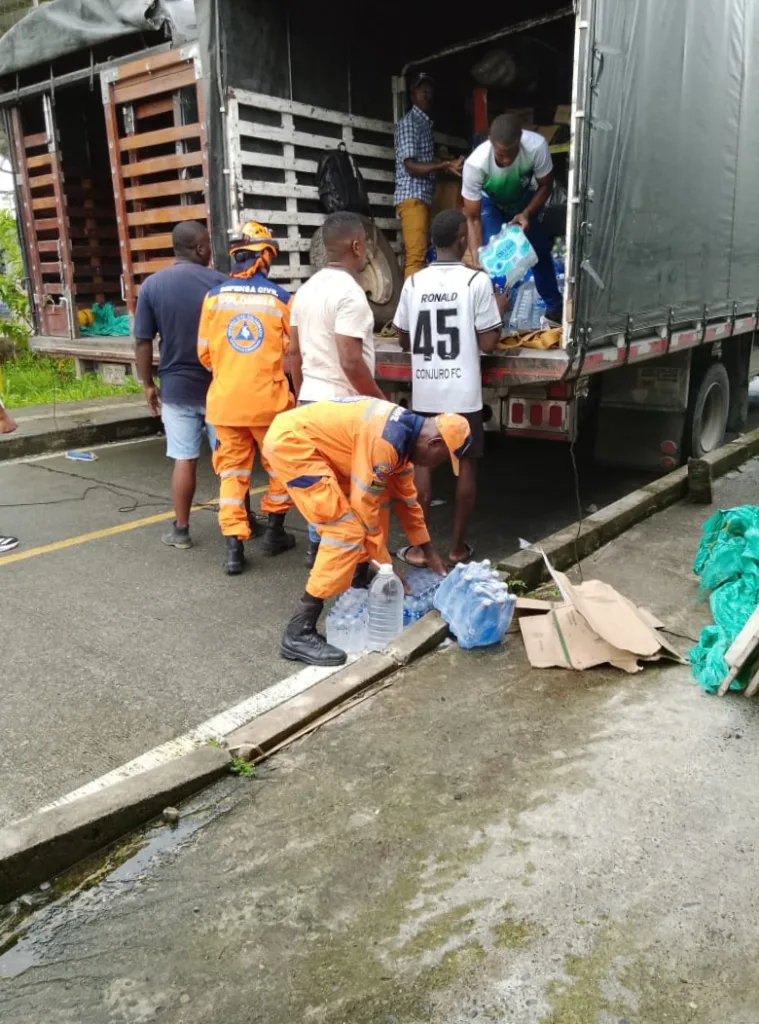
A separate but compounding emergency has affected coastal communities in Buenaventura. On the night of August 15–16, a spring-tide storm surge, known locally as a fenómeno de puja, flooded Juanchaco, Ladrilleros, La Bocana, and Punta Soldado. Sea levels reached approximately 4.91 meters, forcing residents to move belongings from their homes.
Egido Sanz, Acting Country Director of ActionAid Colombia, said:
“The flooding in Buenaventura and Chocó is another catastrophe for communities already dealing with the effects of the earthquake. For rural communities that were already difficult to reach, high water levels will make delivering aid even more challenging. It is vital that these communities are not forgotten and receive the urgent support they need.”
ActionAid is working with local organizations with a longstanding presence in affected areas, alongside public authorities, UNICEF, and the World Food Program, to support the wider response in Buenaventura. Current activities include food assistance, health support through Barco Hospital San Raffaele, and preparations to distribute 250 family hygiene kits in temporary shelters. Essential items, personal care kits, and shelter supplies are also being distributed through civil society organizations EMAÚS Buenaventura, Fundación Huellas que Transforman (Footprints that Transform), and Fundación Vida (Life Foundation).
Further support for Indigenous and Afro-Colombian communities will be shaped by local assessments, including those being conducted by other ActionAid Colombia partners, and the priorities identified by affected communities.
Ends
Spokespeople are available for interviews (Spanish and French). Spokespeople are available for media engagements. For media requests, please email christal.james@actionaid.org or call 7046659743.
About ActionAid
ActionAid is an international network building a just, equitable, and sustainable world in solidarity with communities on the frontlines of poverty and injustice. ActionAid USA is the U.S. member of the ActionAid federation, based in Washington, D.C.