


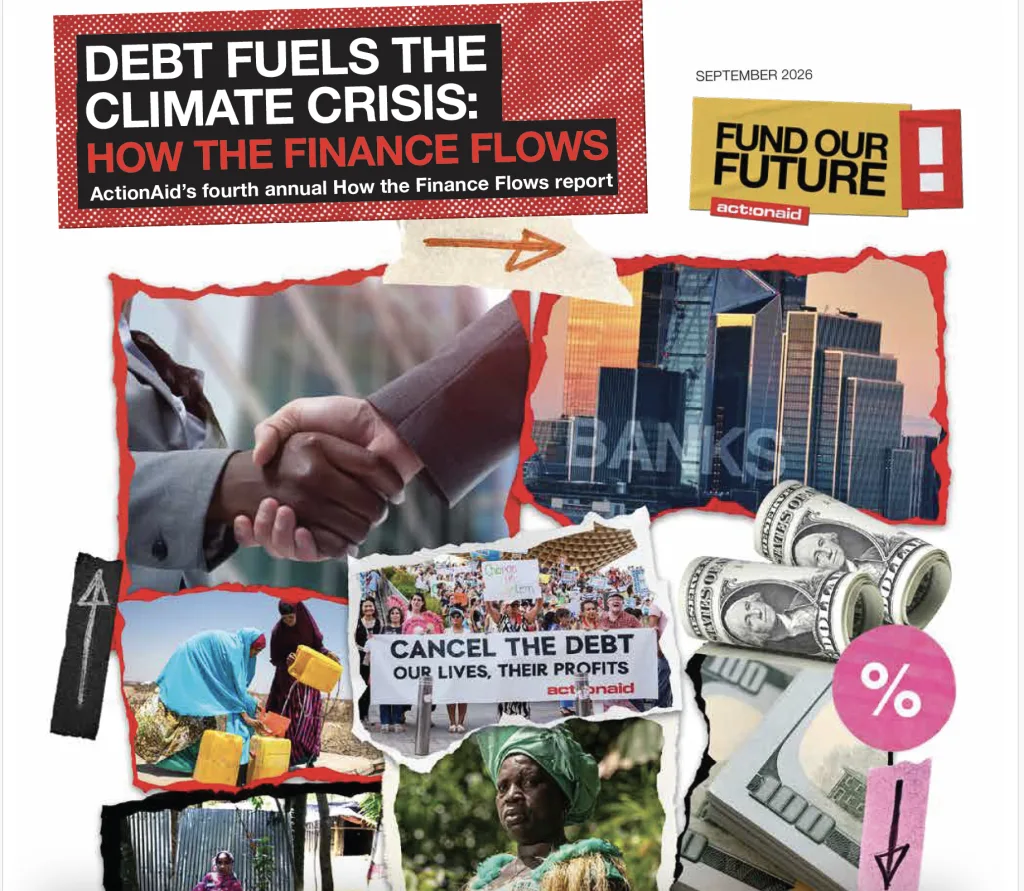
Debt is blocking climate action, and breaking the debt trap is one of the most powerful and achievable solutions within reach.
- A new report finds that the most climate-vulnerable countries are spending nearly 25 times more on debt repayments than on climate action, while debt servicing absorbs 65% of their combined government revenue.
- The Global South is paying approximately 225 times more in debt repayments than it receives in grant-based climate finance – US$8.8 trillion in repayments in 2026 compared with the latest figure of US$39 billion in climate grants in 2024.
- 93.5% of the most climate-vulnerable countries are in, or at significant risk of, debt distress.
- Debt cancellation in climate-vulnerable countries could fund their basic, unconditional national climate plans six times over, or cover current climate, health, education and social-protection spending combined, twice over.
ActionAid’s new flagship report, Debt fuels the Climate Crisis: How the Finance Flows, reveals the scale at which sovereign debt is draining resources from countries on the front lines of the climate crisis and leaving communities dangerously exposed to worsening floods, droughts, heat and hunger.
Released on September 16, 20226, the report analyses public revenues, debt repayments, national budgets and climate plans across the 65 most climate-vulnerable countries. It concludes that debt and climate are locked in a vicious cycle, but one that can be broken through debt cancellation, grant-based climate finance, and a fairer international debt system.
Arthur Larok, the Secretary-General of ActionAid International, says:
“For too long, the debt and climate crises have been treated separately. This research exposes how tightly they are connected and quantifies the devastating cost involved.
Yet this is a crisis we can fix. Action on debt can unlock countries’ own resources on a scale that few other climate measures can match, protecting lives now while creating space for a safer and fairer future.”
The report identifies a vicious cycle: climate disasters force countries to take new loans to recover; debt repayments and austerity then squeeze investment in response, resilience, essential public services and a just transition. To earn the foreign currency demanded by lenders, governments also face pressure to expand fossil fuel extraction and industrial agriculture, driving more emissions, ecological damage and climate disasters – and still more debt.
Two-thirds of what rich countries label climate finance arrives as loans rather than grants, much of it at high commercial interest rates. This creates an illusion of support while pushing recipient countries further into debt.
Niranjali Amerasinghe, Executive Director of ActionAid USA, says:
“Rich countries, like the US, have outsized global financial power. Their lack of willingness to provide climate finance at scale and relieve the debt burden of climate-vulnerable countries is unconscionable. There are trillions for defense budgets but peanuts for the biggest existential crisis of a generation.”
Teresa Anderson, Global Lead on Climate Justice at ActionAid International and one of the report’s authors, says:
“Debt is a triple whammy for the climate: it drives fossil fuel and industrial agriculture expansion, blocks vital climate action, and leaves communities dangerously exposed when disasters strike.
This is a toxic relationship. Countries borrow to rebuild, austerity weakens their resilience, and repayment pressures push more extraction, fuelling the next disaster. We need a break-up: cancel unjust and unsustainable debt, stop making countries borrow to survive climate impacts, and deliver climate finance as grants rather than loans. This vicious cycle can and must be broken.”
The report also provides examples of how debt drains resources away from climate solutions. In Senegal, debt servicing in 2026 is more than 600 times the country’s budgeted spending on climate action and exceeds 96% of government revenue. It shows that high debt levels are delaying investment in agroecology, a people-led solution that can strengthen food security, livelihoods and climate resilience.
Khaita Sylla, Country Director of ActionAid Senegal, says:
“In Senegal, the red flags could not be clearer. Debt repayments consume more than 96% of government revenue. For every US$1 allocated to climate action, the country is spending US$605 on debt servicing.
Behind these figures are impossible choices between servicing debt and investing in agroecology, public services and climate resilience. Women and girls who bear the brunt of climate impacts are then disproportionately affected by cuts in public services even as they lead solutions for a more resilient future.”
The report is being launched during the Global Week of Climate Action (September 14–20), when ActionAid will be joining forces with young activists and social movements worldwide to urge governments and international financial institutions to confront the interconnected debt and climate crises. These mobilizations are part of ActionAid’s #FundOurFuture campaign, which calls for debt cancellation, a fossil-free future, and grant-based financing for climate adaptation, a just transition, and community-led solutions such as agroecology.
Michael Mwansa, a young climate activist and ActionAid Zambia’s Thematic Lead on Climate Justice, says:
“In Zambia, young people are living with decisions made in distant boardrooms: debt is squeezing our national budget while climate shocks threaten livelihoods, energy, agriculture and opportunities. But we are not simply bearing these consequences; we are organizing our communities, sharing solutions, and demanding a say in the decisions shaping my country and our future.
The Global Week of Climate Action is an opportunity that makes leaders in Zambia and around the globe impossible to ignore. My generation and those coming deserve more than a future defined by debt and climate hazards and disasters. We deserve a fair voice, resources to act and the chance to build a safer future on our own terms.”
In the report, ActionAid and its allies are calling for governments and international institutions to:
- Cancel unpayable or unjust debt for countries spending more than 10% of their revenues on external debt repayments.
- Agree a universal rule to suspend debt payments for any country hit by a climate disaster, applying to all creditors, not only those who volunteer.
- Create a UN Framework Convention on Sovereign Debt that gives indebted countries an equal voice and establishes a fair multilateral debt-resolution mechanism.
- Legislate in London and New York to require private creditors to take part meaningfully in debt restructuring. Around 90% of sovereign bond contracts are governed by UK law.
- Regulate existing Credit Rating Agencies to remove conflicts of interest and bias, and establish regional and public credit rating agencies or a multilateral credit rating agency.
- Ensure that climate finance comes in the form of grants, not loans or any other debt-creating financial instruments, and is sufficient to meet the scale of the climate crisis.
- Reform debt-sustainability assessments so that climate responses, public services and human rights are central to decisions about what countries can afford to repay.
- Conduct public debt and climate audits in countries facing debt crises to examine how domestic and external debt deepen climate impacts, poverty and exclusion – particularly for women and girls – and identify actions to break the cycle.
Ends
Spokespeople are available for media engagements. For media requests, please email christal.james@actionaid.org or call 7046659743.
Notes to editors:
- This press release and the report are embargoed until 00:01 GMT on Wednesday, September 16, 2026.
- ActionAid will host a public webinar about the report’s findings on Wednesday, September 16, 2026, 08:00 EDT/ 12:00 GMT/ 13:00 BST/ 14:00 CEST/ 15:00 EAT/ 18:00 Bangladesh Standard Time. Please contact christal.james@actionaid.org for more details or to confirm your interest.
- The full report, Debt fuels the Climate Crisis: How the Finance Flows, will be available online at 00:01 GMT on Wednesday, September 16, 2026, here.
- Methodology: ActionAid has worked with Development Finance International (DFI) to analyze the available data on the domestic revenues, debt, national budgets, and climate plans within the 65 countries (i.e., the top third) that are most vulnerable to climate change. Full sources, country coverage, and methodological details are provided in the full report.
- This is the fourth of ActionAid’s annual How the Finance Flows flagship report series, scrutinizing the finance flows fueling the climate crisis. Earlier reports examined how global banks finance fossil fuels and industrial agriculture in the Global South (2023), public funds and subsidies supporting these sectors (2024), and the limited climate finance reaching just-transition approaches (2025).
About ActionAid
ActionAid is an international network building a just, equitable, and sustainable world in solidarity with communities on the frontlines of poverty and injustice. ActionAid USA is the U.S. member of the ActionAid federation, based in Washington, D.C.