


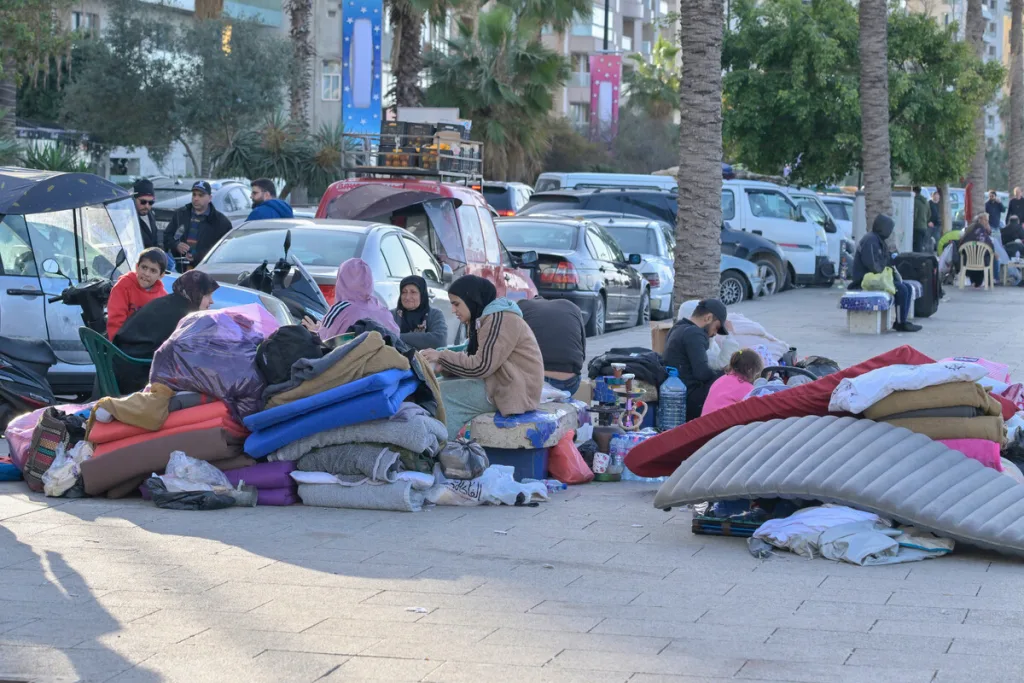
Terrified residents living near the so-called yellow line in Lebanon are reporting ‘constant bombings’ as the Israeli army continues to destroy buildings and infrastructure in the area it occupies south of the line, despite the ceasefire agreed on April 16.
The Israeli army has established control over around 602 square kilometers of land in southern Lebanon – amounting to 5.8% of Lebanese Territory – and deemed it a no-go zone, marked by what it calls the yellow line, preventing residents who have been forcibly displaced from returning to their homes and isolating those that remain from the rest of the country.Maya*, who lives in a village next to the yellow line, told ActionAid:
“My village lies next to what they call the ‘yellow line’ [in southern Lebanon]. This is effectively a line that is preventing residents from returning to 55 Lebanese towns located within it. We returned after the ceasefire, hoping for some sense of safety, but we could not sleep–not at night, or even during the day. All the village is shaking from the sound of constant bombings. Israeli strikes are demolishing buildings in nearby villages, one after another.
Israeli soldiers are reportedly carrying out widespread and systematic destruction of homes and infrastructure in the ‘buffer zone’ south of the yellow line, acts that could amount to war crimes. This mirrors the same tactics the Israeli military has been using in Gaza, where satellite imagery has revealed that entire neighborhoods behind the Israeli-imposed ‘yellow line’ have been razed to the ground.
Maya said:
“A lot of people in the neighboring villages went back to their homes, only to find them completely or partially destroyed. They had no choice but to leave again, fleeing to overcrowded shelters or staying with relatives. Our village is now almost empty. We came back looking for home, but instead, we found more fear, more loss, and more uncertainty.”
The creation of a so-called ‘no-go’ or ‘buffer’ zone in southern Lebanon amounts to a de-facto Israeli military occupation, raising serious concerns that it could result in long-term control over Lebanese land. In Gaza, the Israeli army currently controls 58% of the territory, deeming the entire strip of land behind the ‘yellow line’ a no-go area, killing Palestinians who enter or approach it: UN data shows that 269 people, including 100 children, were shot near the yellow line over the course of six months. In recent days, the ‘yellow line’ appears to have shifted yet again to encroach further onto Palestinian territory, reaching the Salah Al Din Road, a main route through Gaza, according to reports. ActionAid warns that the Israeli forces are acting with complete impunity across the region and fears they are pursuing a strategy of territorial expansion in both Gaza and Lebanon.
All across Lebanon, the humanitarian situation remains dire, with more than a million people still displaced from their homes. Many families who, at the start of the so-called ceasefire, briefly returned to their homes in the southern suburbs of Beirut or southern Lebanon, have been forced to flee again due to continued airstrikes or because their homes have been destroyed.
Displaced people face difficult conditions, with the majority living outside of formal shelter systems in temporary accommodation and often forced to rent at sharply inflated prices, as government-run shelters are extremely overcrowded.
Samia, a volunteer with the Lebanese Women Democratic Gathering (RDFL), ActionAid’s partner in Lebanon, was displaced from her home in Baalbeck to Tripoli in northern Lebanon in early March along with 18 of her family members. Unable to find anywhere to stay but a tiny apartment where they were charged extortionate rent, her family has now returned home despite the danger that persists.
Samia said:
“Tension is still high, and there is a constant fear that the situation could suddenly deteriorate again. Reconnaissance drones are always in the sky, and their noise is disturbing, creating immense psychological pressure and tension. You feel like they are right above your head, and many people were displaced again because of this fear and lack of security.
There might be a ceasefire, but true security is still missing, because the security isn’t just about the bombing stopping; it’s about living without fear, sleeping peacefully, without being afraid of the planes overhead or of the possibility that everything could collapse again.”
Ghassan, a driver from ActionAid partner RDFL, who lives in Dayiheh in the southern suburbs of Beirut, decided to stay at home despite the danger from Israeli army strikes while the rest of his family was displaced. He said:
“I sent my family to the mountains for safety. Strikes hit next to my home, sometimes without warning. One night, I woke up to a powerful explosion. I ran to help and found people injured, including people working with humanitarian organizations I know.”
He said the so-called ceasefire brought little change to the situation:
“Despite the ceasefire, fear is still here. Only a few families have come back. Most shops are still closed. Schools remain shut. The scale of destruction this time is even greater than in 2024.
Thousands of homes are gone. Mine was damaged, but still standing. Others have lost everything. A friend of mine has lost his home three times: in 2006, in 2024, and again [now] after trying to rebuild. How many times can people lose everything… and still be expected to start again?”
An ActionAid spokesperson said:
“As the death toll rises and destruction continues, it’s clear the so-called ceasefire in Lebanon is nothing but an illusion. The situation right across the country remains extremely volatile and unsafe, and forcibly displaced people remain trapped in an unbearable limbo, with no certainty of when they might be able to go home.
In plain sight of the world, the Israeli army is repeating the same tactics it has used to such horrific effect in Gaza and de-facto occupying part of the country, expelling residents en masse and turning entire villages into militarized no-go zones. Preventing forcibly displaced people from returning to their homes is against international humanitarian law. The world cannot continue to allow the Israeli authorities to act with impunity, both in Lebanon and across the occupied Palestinian territory where it is committing the same violations. There must be a real, region-wide ceasefire now that truly protects civilians and ensures aid reaches those who need it, and full justice and accountability.”
ENDS
Spokespeople are available in Lebanon and the occupied Palestinian territory. For media requests, please email christal.james@actionaid.org or call 7046659743.
About ActionAid
ActionAid is a global federation working with more than 41 million people living in more than 71 of the world’s poorest countries. We want to see a just, fair, and sustainable world, in which everybody enjoys the right to a life of dignity, and freedom from poverty and oppression. We work to achieve social justice and gender equality and to eradicate poverty. n which everybody enjoys the right to a life of dignity, and freedom from poverty and oppression. We work to achieve social justice and gender equality and to eradicate poverty.