


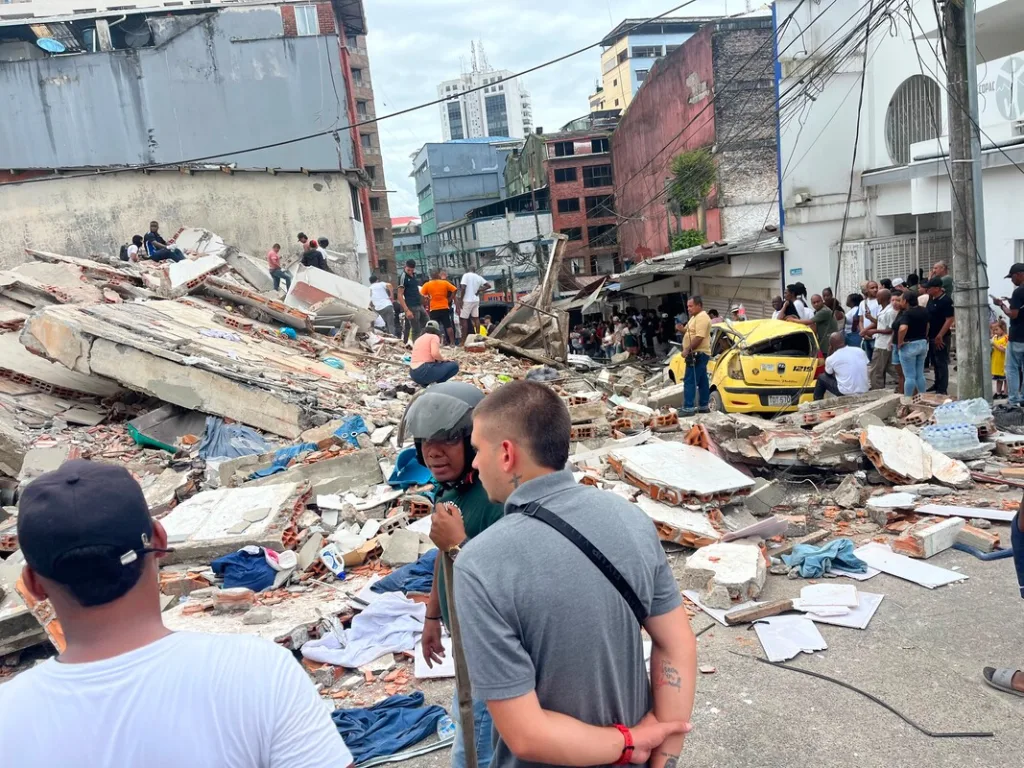
Women and community leaders across Chocó and Buenaventura are organizing support and identifying urgent needs following the 7.4-magnitude earthquake, as ActionAid warns that longstanding inequalities risk leaving Indigenous and Afro-Colombian communities in rural regions behind.
The earthquake has killed 241 people and injured 3,771, with a further 287 people still missing and an estimated 49,214 people affected. Around 10,000 buildings have been damaged, including 796 schools, 186 health centers, 527 community centers, and 45 water systems, as well as 125 roads and seven airports. The earthquake has affected 12 departments and 335 municipalities, with Risaralda, Valle del Cauca, Chocó, and Caldas among the worst affected. Almost two million people live across the affected areas, many in communities already facing significant humanitarian needs before the earthquake struck. In the first six months of 2026 alone, armed conflict confined 12,646 people in Chocó, restricting their movement and access to essential services. Across Colombia, nearly 65,000 people were affected by conflict-related confinement during the same period, according to the country’s Ombudsman’s Office.
Egido Sanz, Acting Director of ActionAid Colombia, said:
“We are facing a natural event whose impact has been profoundly exacerbated by years of exclusion and insufficient institutional presence.”
Local women and community leaders responding to the devastating earthquake in western Colombia are calling for urgent resources to support families who have lost homes, relatives, and possessions, as new testimony gathered by ActionAid reveals both the scale of destruction and the community-led response underway.
In Buenaventura, on Colombia’s Pacific coast, community leaders are working to identify what families need and calling for resources, including food, shelter materials, and medicines. Daira Perlaza Valencia is the legal representative of ASOCHIP, a predominantly women-led Afro-Colombian community association representing farmers and papachina processors in Bajo Calima.
Daira says:
“Some people have no shelter and nowhere to go. We have not even received any food yet; nothing has reached our community. We are waiting for help with mattresses, mosquito nets, and food… and medicines to treat wounds, because many people were injured by things falling from the roofs of their homes.”
In the Rockefeller neighborhood of Buenaventura, Rosinda Ariasco, president of the neighborhood’s grassroots community association, is also helping represent families affected by the earthquake and calling for authorities to support the local response.
Rosinda said:
“Right now, we are dealing with the aftermath of the earthquake that struck on Monday, which damaged many homes. Many families are currently displaced. We are seeking support from anyone who can help, so that we can bring a little more relief to these families who need us at this time.”
The scale of the loss is devastating, and Claudia Ximena, who also lives in the Rockefeller neighborhood, shared her testimony with ActionAid while standing in front of the remains of the five-story building where her family lived. Claudia was away from home with her husband when the earthquake struck. Her mother-in-law and a young girl who lived with her died, while her nephew was seriously injured. She says:
“My mother-in-law passed away, along with a little girl who lived with her. My nephew is badly hurt…We have been left without even our clothes. We do not have so much as a spoon. Nothing, nothing. We have nothing left.”
Hundreds of kilometers of difficult terrain, damaged transport routes, and limited communications are complicating efforts to establish the full extent of the earthquake’s impact across Colombia’s Pacific region.
In Medio Baudó in Chocó, Dilia Córdoba Castro, an environmental defender and representative of the Women Recyclers’ Association of Medio Baudó, is among the local women documenting the damage and identifying what affected families need. Dilia reported approximately 500 homes affected in her municipality, including 85 completely destroyed and around 300 sustaining an estimated 70% damage. She said:
“The municipal government, Civil Defense, and firefighters are trying to conduct a census and support community kitchens, but they cannot meet the scale of the needs. Our immediate needs include bed sheets, food, and kitchen supplies. The situation is extremely difficult, and some people have lost absolutely everything.”
The earthquake has struck predominantly Afro-Colombian and Indigenous communities in areas already affected by armed conflict, displacement, poverty, geographical isolation, and unequal access to water, healthcare, and other essential services. ActionAid Colombia has warned that these longstanding inequalities are shaping both the impact of the earthquake and communities’ ability to recover.
Egido Sanz, acting Country Director of ActionAid Colombia, said:
“An earthquake is a natural phenomenon, but the scale of the disaster cannot be explained solely by the movement of the Earth. It has struck areas already marked by poverty, armed conflict, geographical isolation, the precarious conditions of many homes, and very limited access to water, healthcare, and other essential services…. We are facing a natural event whose impact has been profoundly exacerbated by years of exclusion and insufficient institutional presence.”
While rescue efforts and international attention have focused heavily on more accessible urban areas, ActionAid is concerned that communities facing the greatest barriers to access could receive less support.
Egido also said:
“Urban areas are more visible and easier to access, so there is a risk that humanitarian aid will be concentrated there whilst rural communities remain neglected.”
Local and women-led organizations have been responding since the first moments after the earthquake, drawing on their knowledge of their communities and existing networks to identify needs and provide support.
Egido added:
“There are women’s organizations that are supporting families, identifying needs, distributing aid, and offering protection and emotional support using their own resources. This community-led response based on solidarity places an enormous physical, emotional, and financial burden on people who have themselves been affected by the earthquake.”
In Buenaventura, ActionAid is supporting food assistance with UNICEF and the World Food Program, while support is being mobilized for emergency health needs in harder-to-reach communities, including medical and laboratory supplies, at a time when health facilities have themselves been damaged or overwhelmed.
For Indigenous and Afro-Colombian communities in the region, planned support includes hygiene and dignity kits, while further assessments with local partners will help determine how to prioritize the remaining emergency funds. Egido said resources must reach the organizations already rooted in affected communities:
“It is also essential that resources reach local organizations, which already have access, experience, knowledge and the trust of the communities, in a flexible and timely manner…Strengthening these capacities will enable aid to reach people more quickly and truly address the communities’ priorities.”
Ends
Spokespeople are available for interviews (Spanish and French). Spokespeople are available for media engagements. For media requests, please email christal.james@actionaid.org or call 7046659743.
About ActionAid
ActionAid is an international network building a just, equitable, and sustainable world in solidarity with communities on the frontlines of poverty and injustice. ActionAid USA is the U.S. member of the ActionAid federation, based in Washington, D.C.