


By Sujeeta Mathema, Executive Director at ActionAid Nepal
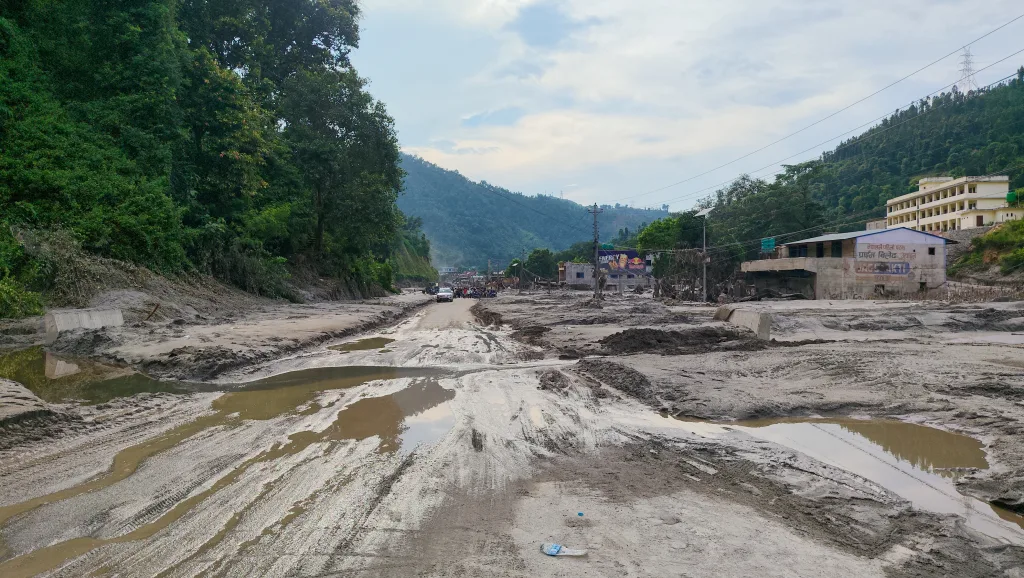
As I met with survivors at a shelter in Nuwakot district, one of the areas most affected by the catastrophic flash flooding that struck on August 26, and heard their stories of loss, the sheer scale of the disaster felt almost incomprehensible.
Nearly every household has lost someone. Whole communities are in mourning; entire schools are grieving for students who will never return to class. People have lost their homes and the land they depend on for their livelihoods.
Essentials like food, blankets, and sleeping bags are urgently needed, but recovery will take more than just relief supplies. Nepal’s disaster authorities estimate that $2.56 billion worth of property, housing, and infrastructure has been damaged. The immediate cost of early recovery alone is expected to be around $53 million.
Behind these numbers lies a question the international community can no longer avoid: who pays when countries that are least responsible for the climate crisis suffer catastrophic losses?
Nepal contributes less than 0.1% of the world’s annual global greenhouse gas emissions. Yet it is one of the most climate-vulnerable countries due to its geographical location in the Himalayan mountains, where the warming climate is accelerating glacier melt and increasing the risks of glacial lake outburst floods, ice avalanches, and glacier collapse.
Nepal has known about these risks for years. The disaster appears to have been triggered by a major collapse of glacier ice, rock, and bedrock, setting off a cascading flood and debris to flow through the Bhotekoshi and Trishuli river systems. Scientists are still establishing the precise sequence of events, including the role of glacial and temporarily dammed water. What is already clear is that the disaster exposes the growing risks posed by a warming climate and an increasingly unstable Himalayan environment.
Countries like Nepal cannot be expected to shoulder the cost of rebuilding after climate-related disasters alone. Nepal should not have to choose between recovery and investing in schools, healthcare, or development. Nor should it be pushed further into debt to recover from climate impacts it did little to cause.
This is why the international community established the Fund for Responding to Loss and Damage. The principle is straightforward – when climate change causes losses that adaptation cannot prevent, vulnerable countries are owed financial support to recover and rebuild.
Since the fund was established in 2022, it has been inundated with requests amounting to around $2.8bn, from around 119 countries, including Nepal, which submitted three separate proposals. Yet the Fund only has around $350m in cash actually available for disbursement, and to date, it has not yet released any of it.
Nepal has now formally asked the Fund for emergency assistance following the Bhotekoshi disaster. Members of the Fund’s board have called for an extraordinary meeting to consider the request. This is the moment when the Fund must prove it can be more than another international mechanism that promises action while communities wait.
If a catastrophic climate-related disaster of this scale does not trigger rapid support, what exactly is the Loss and Damage Fund for? The answer cannot simply be another expression of solidarity.
Nepal needs money urgently. It needs support to restore essential services, rebuild, recover livelihoods, and prepare for the next disaster. And that funding must be provided as grants, not loans that leave already vulnerable countries carrying yet more debt.
Nepal should not have to wait. Yet previous experience has proven just how slow the global climate finance system can be. For example, a Green Climate Fund (GCF) project to reduce the risks from glacial lake outburst floods and climate-induced flooding in Nepal was in the pipeline for seven years before being approved in July 2025. It entered implementation only in March this year.
The geographical focus does not overlap with the site of the August 26 disaster, and earlier implementation would not have stopped that tragedy from unfolding. But its seven-year journey through the climate finance system illustrates a much bigger problem: finance is moving far too slowly for a country facing multiple, known and escalating climate-related risks.
For communities living beneath increasingly unstable mountains, seven years is not an administrative inconvenience – it is a lifetime in which the risk continues to grow. Our demand is clear: climate finance must be issued promptly, and it must flow beyond national governments to the local communities facing immediate risks, particularly women’s organizations and grassroots groups leading local preparedness, livelihood protection, and recovery.
The people of Nepal are not asking for charity. They are asking for justice. Countries and companies that have benefited most from fossil-fuel-driven economic growth have far greater resources and historical responsibility for the emissions that have warmed our planet. Meanwhile, countries such as Nepal are being asked to absorb the economic and human costs.
That is not inevitable: it is a political choice. The international community can continue with a system in which vulnerable countries wait years for adaptation finance and then scramble for humanitarian assistance when disaster strikes. Or it can recognize that climate justice requires finance that is adequate, predictable, accessible, and disbursed speedily to match the risks people face. Nepal’s disaster should be a test for the Fund for Responding to Loss and Damage and for those who have promised to support it.
Nepal must not simply be presented as a case study of climate vulnerability. Countries around the world must stand with Nepal in solidarity and support the resources needed to build resilience. Nepal did not create this crisis – it should not be left to pay the bill for it alone.
ollapse or a triggered landslide/ ice avalanche, although this is still being confirmed through the scientific analyses, as far as I can see:
I just want to make it clear that these are separate types of hazards. Nepal has known about GLOFs for decades now, and has been tracking high-risk glacial lakes, but from what I can see, this glacier collapse/ avalanche was triggered from a place that was previously not on the risk radar.