


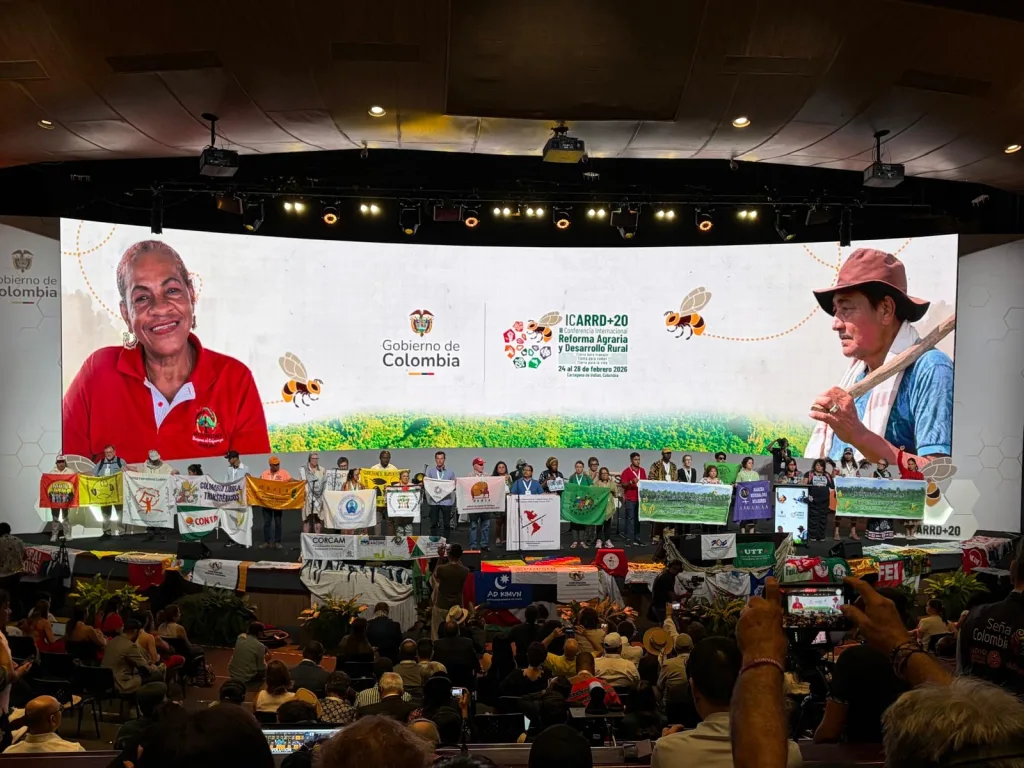
Over 1500 people, including official delegations from 56 governments, representatives of many international institutions, 400 researchers and scholars, and hundreds more representatives of social movements and Indigenous Peoples, gathered in the city of Cartagena, Colombia, from February 24 to 28 to participate in the 2nd International Conference on Agrarian Reform and Rural Development (ICARRD+20). I participated as one of the 300 delegates of the International Planning Committee for Food Sovereignty (IPC), which brought together social movements from 70 countries, including peasants, pastoralists, fisherfolk, workers, and Indigenous Peoples.
IPC members came together in a Social Forum for two days before ICARRD+20 to analyze our position and prepare an opening declaration for the conference and organize our participation in the plenary and dozens of parallel sessions. On behalf of ActionAid USA, I attended as one of the representatives of the US Food Sovereignty Alliance, which was part of a North American delegation that included representatives of Indigenous Peoples, and family farmers and fishers’ organizations from the US and Canada.

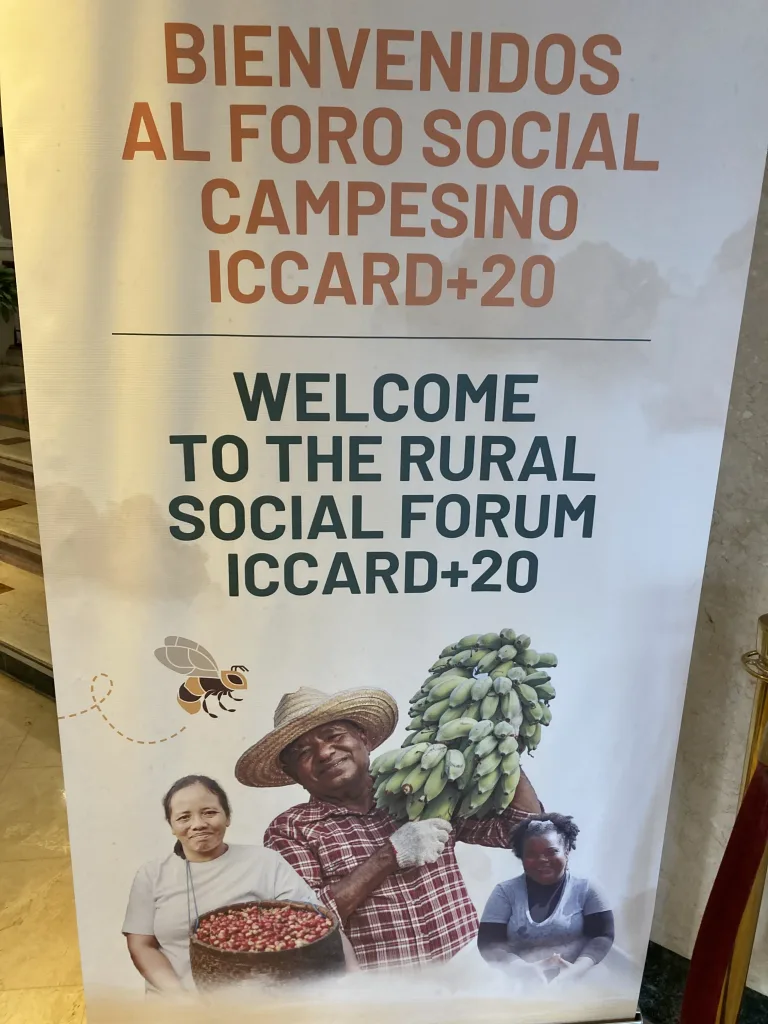
At the IPC social forum, we affirmed our collective vision for an agrarian reform rooted in a framework of four Rs:
- Regulation: Implementing strict public interest regulations to limit the influence of market forces and financial speculation on natural resources.
- Recognition: Respecting and protecting collective and customary tenure systems, particularly for Indigenous Peoples and marginalized communities.
- Redistribution: Ensuring the equitable transfer of land, power, and wealth to landless peasants, women, and youth, while placing caps on corporate land ownership.
- Restitution and Reparation: Restoring control to those dispossessed by colonization, conflict, and forced evictions, including the settlement of historical debts to Indigenous nations.
Key demands of the forum included the acknowledgement of the root causes of the multiple crises we face around inequality and food security, a commitment to ending the commodification of nature, and a shift of power from corporations to people, with special attention towards women, youth, and gender-diverse and sexually-diverse peoples.
Forum participants called for implementation of national policies of agrarian reform that are “integral and feminist,” meaning that they include the above, also just transitions to agroecology, social protections, healthcare, education, and access to resources, prioritizing “the rights of women, youth, and landless workers – especially historically oppressed groups and castes.” We demanded an end to corporate resource grabs and the removal of land and water from “the logic of speculative markets.”
Finally, we proposed the strengthening of monitoring systems for the implementation of the Tenure Guidelines through the UN Committee on World Food Security (CFS), and that proposals and conclusions on agrarian reform be reported to all relevant UN institutions and the Rio Conventions (on biological diversity, climate change, and desertification). We called for the establishment of agrarian reform observatories at international, national, and local levels, and the reform of the UN Food and Agriculture Organization (FAO)’s Global Land Observatory “into a participatory platform for community-led data.”
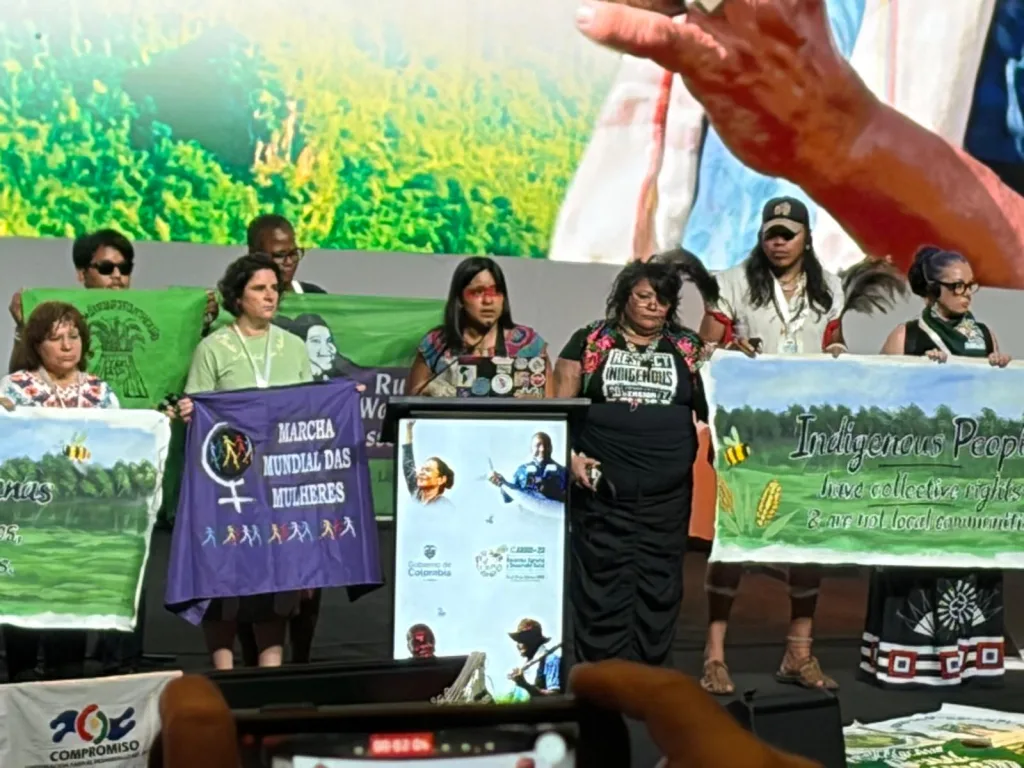
IPC delegation members and allies made the urgency of these demands and proposals clear throughout the conference’s four days of plenary sessions and many parallel events. The governments of Colombia, Brazil, South Africa, and others presented the advances and challenges in implementing agrarian reform programs in their countries. The FAO presented the Global Land Observatory’s first report on “The status of land tenure and governance.” This highlighted the extreme inequality in agricultural landholdings, with the largest 10% of farms occupying 89% of all farmland, while noting that land tenure insecurity is rapidly rising, with 23% of the world’s adult population concerned that they will lose their land or housing in the next few years.
During a well-attended panel on Territory for Life: Innovation for a just use of land, Jordan Treakle of the US National Family Farm Coalition, representing the US Food Sovereignty Alliance, described how innovation in the US has often worked to create corporate concentration in agriculture to the detriment of rural communities, family farmers, and consumers:
“Both corporate ownership of agricultural land and the price of land are at historic highs in the US, which locks out new and beginning farmers from accessing land and joining the sector, the land rush in rural American is being led by private equity, pension funds and increasingly data companies, consolidating a model of land ownership where people who live in local communities do not control the land that live on. The territory is being controlled by executives in New York and Silicon Valley.”
Unfortunately, the massive participation and the strength of the concepts and examples presented at the conference did not transfer directly into the strong consensus-based declaration of governments that social movements had hoped for. Even worse, it contained a poison pill by including the conflation of “Indigenous Peoples and Local Communities.” The phrase fails to distinguish the specific rights of Indigenous Peoples by equating them with the undefined term of local communities. It allows some states to refuse to recognize indigenous Peoples by labelling them as local communities, and it also makes invisible the specific rights of communities and groups that were recognized in the UN Declaration of the Rights of Peasants and Other People Working in Rural Areas (UNDROP) in 2018.
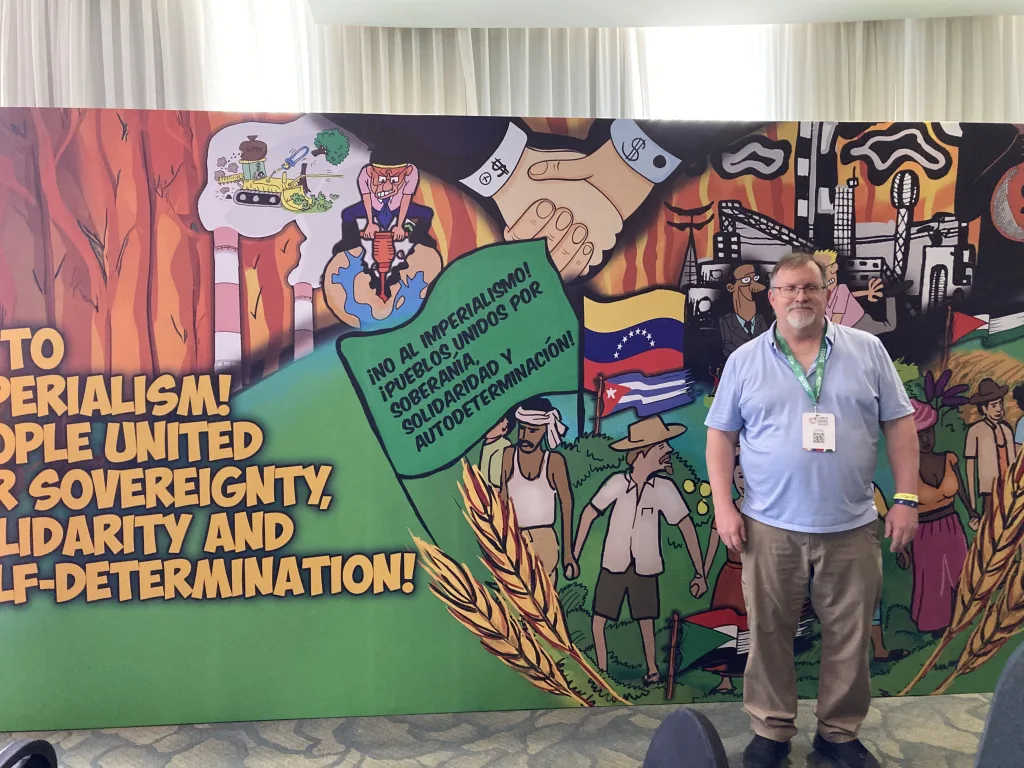
Representing the US Food Sovereignty Alliance, I participated in the unanimous decision of the IPC delegation not to accept the governments’ declaration because of the poison pill phrase and other weak language in the declaration, in spite of the efforts of Colombia and Brazil to make the declaration stronger.
It is likely that the phrase “Indigenous Peoples and Local Communities” was inserted by one or two governments seeking a loophole to avoid recognizing Indigenous Peoples, while other governments with inexperienced delegations in the subject matter supported them out of a desire to wrap up negotiations on schedule and ignorance of the reasons and strength of the social movements’ objections.
Fortunately, we were able to make our position clear in a way that is unlikely to be ignored in future negotiations, as the government of Colombia honored the request of the IPC delegations to fill the ICARRD stage in the closing session with a representative of each social movement. The Indigenous representative Taily Terena of Brazil read our final collective statement, which rejected the governments’ declaration while thanking Colombia and expressing a willingness to work together for an ongoing ICARRD process that would include bringing agrarian reform back into the CFS and relevant UN policy spaces.
The conference was then closed with a strong speech from Colombia’s Minister of Agriculture, Martha Carvajalino, who has led the Colombian government’s advances in agrarian reform. She expressed gratitude for the voices of social movements and welcomed disagreement and dialogue. She took note of the progress made at ICARRD+20 through the presentation of ideas and experiences regarding agrarian reform after many years of the subject lying dormant.
Carvajalino proclaimed that, “agrarian reform and rural development are the essence of a humanity that is just, viable, and sustainable. I am excited to tell you today that we have the possibility to say that we are on the path so that in less than 3 years we could have the 3rd International Conference on Agrarian Reform and Rural Development.” She said that ICARRD+20 had opened the way to build a mechanism among states to formalize an ICARRD process and decide where to hold the next conference. She said that Indonesia, South Africa, and Mexico were possibilities suggested so far.
In a media interview after the conference, Minister Carvajalino presented a way forward by stating that participating countries had prioritized three fundamental elements:
- “First, a commitment to the redistribution of land in the logic of justice, in the logic of economic growth, in the logic of addressing the climate crisis;
- Second, rural development must be sustainable and resilient, and it must understand that in the face of the climate crisis, it is time to take action regarding the soil, the water, the forests, and biodiversity.
- And a third element, a global action by countries to establish, with bodies like the [UN] Food and Agriculture Organization, a logic for technical assistance and financing for agrarian reforms.”
Carvajalino said that with ICARRD+20:
“The world has returned to the understanding that without agrarian reform there is no social justice, that without agrarian reform the climate crisis cannot be addressed, that without agrarian reform there is no economic growth. The fight against hunger necessarily involves agrarian reform!”
Alongside our allies in IPC, social movements, and indigenous peoples’ organizations, we look forward to working with Colombia and other governments that are genuinely interested in a real agrarian reform agenda. We will continue to engage in the ICARRD process as it moves forward, and explore other opportunities to advance this agenda