


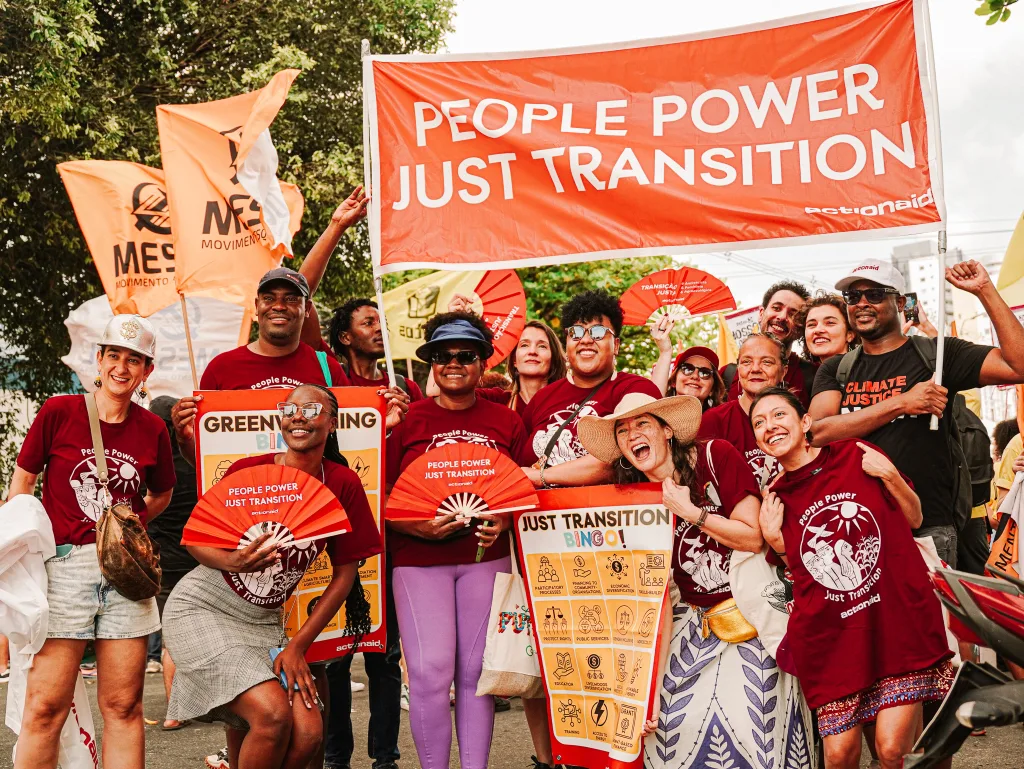
ActionAid USA engaged in COP30 from a policy and campaigns perspective, with a focus on climate finance, loss & damage, forests & land, and just transition. The ActionAid federation had a strong presence, anchored by team members from ActionAid Brazil and our Global Secretariat, which included representatives from country offices and affiliated youth activist programs across the Americas, Africa, and Europe.
We are thrilled to celebrate the decision to establish an institutionalized mechanism for a just transition under the UNFCCC. This was a victory made possible by civil society organizing, including ActionAid’s, over the past several years. However, we are largely disappointed with the other major headline outcomes from COP30, including climate finance, deforestation, and the fossil fuel phase-out.
ActionAid as a whole had nearly 1,000 press hits during COP30, including in the Associated Press, Reuters, The Guardian, CNN, Washington Post, Forbes, and more. For ActionAid USA, a highlight was an interview on Democracy Now! with our Director of Policy and Campaigns, Brandon Wu, debriefing the outcomes of COP30 immediately after it closed. Brandon also had an op-ed published in Climate Home News on the final planned day of negotiations, pushing back against a problematic “blame game” that would have let rich countries off the hook for their intransigence.
From ActionAid USA’s perspective, while no US officials were present to advocate at COP30, there was still a great deal to be done to try to move the needle on our areas of focus. In particular, we supported the centralized civil society push on winning a “Belém Action Mechanism” (BAM) on just transition; we supported demands for stronger outcomes on climate finance; and we worked to support the first call for proposals of the Fund for Responding to Loss & Damage (FRLD).
Much of our work also happened behind the scenes to help ensure different civil society formations – in particular Climate Action Network International and the Global Campaign to Demand Climate Justice – were aligned on their advocacy and messaging strategies. We know from long experience that civil society can only win its priorities if it speaks with one voice. ActionAid’s respected presence across multiple CSO networks enables us to play a key role in convening diverse actors and working toward messaging alignment.
Top-Line Takeaways:
Climate Finance
On climate finance, COP30 was effectively a hangover from the terrible New Collective Quantified Goal (NCQG) decision from COP29. The “Baku to Belem Roadmap” proved to be as meaningless as we predicted – a bone thrown to developing countries to accept an unacceptably low NCQG target that ultimately does nothing to further the cause of increased public climate finance. The G77 push for a workshop specifically on Article 9.1, which sets forth the clear obligation of developed countries to provide public climate finance to developing countries, was a result of last year’s outcome, and one which civil society supported wholeheartedly. The final COP30 decision establishes a workshop on Article 9.1, but in the context of Article 9 as a whole and without affecting the implementation of the NCQG – two caveats that represent a clear watering-down from developed countries.
There was also a much-ballyhooed “tripling of adaptation finance” decision, but as with past announcements, the devil is in the details. The original text was a tripling of adaptation finance from 2025 levels by 2030 – already an outcome that pales in comparison to the needs on the ground. The final agreed text, after being watered down by developed countries, omits the 2025 baseline and extends the target date by another five years to 2035.
The Tropical Forest Forever Fund, a proposal from Brazil developed with other tropical forest nations, also received significant attention when the first funding pledges were announced. ActionAid has serious concerns about the Fund’s design, particularly the financial mechanism, which risks scarce public money in a complicated financial mechanism that may not perform as expected and fails to actually deliver money to the ground. The just over $6 billion in pledges announced falls well short of the $25 billion in ‘sponsor capital’ in the TFFF plans.
Loss & Damage
The major outcome on Loss & Damage at COP30 was the announcement of the first call for proposals from the Fund for Responding to Loss & Damage (FRLD), under its Barbados Implementation Modalities. The FRLD would not exist at all without the consistent advocacy of civil society; even in 2023, when the Transitional Committee that established the FRLD met, it was not clear from the outset that the outcome would be an actual fund rather than some much more nebulous “funding arrangements.” ActionAid’s engagement throughout the process of establishing and designing the FRLD helped make the BIM call for proposals possible.
However, it is important to note that the BIM is limited to only $250 million, a pitiful sum compared to the demands of developing countries and the needs on the ground. Additionally, the BIM is intentionally designed without prejudice towards the long-term policy model of the FRLD. Many key design issues remain in contention – including whether affected communities will be able to directly access FRLD resources, how the FRLD will address rapid-response needs rather than offering funding only through a lengthy proposal cycle, whether the FRLD will use non-grant instruments, how the FRLD will balance direct budget support with robust environmental and social safeguards, and much more. See below for details on our plans for continued advocacy on the FRLD.
Forests & Land
Going into COP 30, there was a great deal of talk of the ‘Forest COP’ taking place at the gateway to the Amazon. However, the official negotiating agenda lacked a clear agenda item for discussion of the key issues facing forests and the land sector. This has been an ongoing issue for the UNFCCC, especially since the negotiations on agriculture have become less compelling. That left forest and land issues largely to the ‘Action Agenda’ and other presidency initiatives and announcements, which, unfortunately, were littered with false solutions and dangerous distractions. ActionAid was particularly concerned with the ‘Belem 4x’ initiative and other proposals on increasing biofuels, which are a known driver of land grabs that never deliver on their climate promises. These initiatives seem to have gained minimal traction but will nonetheless need to be monitored going forward.
Two possible bright spots did emerge. The ‘COP30 Intergovernmental Land Tenure Commitment in tropical forest countries’ saw eleven tropical forest countries and four donor countries commit to scale up and strengthen land tenure rights for Indigenous Peoples, local communities, and People of African Descent under national and subnational laws. Commitments include advancing legal and policy reforms to support community-based tenure rights. Additionally, the Brazilian presidency proposed a roadmap to end deforestation and another to end fossil fuels. While most of the attention during the discussion focused on fossil fuels, the roadmaps were not included in the formal outcome. However, the Presidency announced in the closing plenary that it planned an inclusive process to develop these roadmaps, including the one on deforestation and forests. It is not yet clear how that engagement will be structured, but ActionAid will be following the process closely.
Just Transition
The outcome on just transition is cause for unmitigated celebration – a rarity when it comes to UNFCCC negotiations. The COP30 just transition text is a genuinely remarkable document. Among other things, the decision recognizes that just transition is a cross-cutting, whole-of-society concept – that the idea of ensuring workers and communities are not left behind is applicable across mitigation, adaptation, and addressing loss & damage. It recognizes, in multiple places, the importance of climate finance for enabling just transition pathways in developing countries and twice emphasizes the need to protect fiscal space and avoid creating additional debt burdens. It also highlights that a huge range of communities and populations must be proactively consulted in the creation of just transition plans – including “informal workers, people in vulnerable situations, Indigenous Peoples, local communities, migrants and internally displaced persons, people of African descent, women, children, youth, elderly people and persons with disabilities.”
Of course, some aspects of the decision could be stronger – most notably, it does not actually establish a just transition mechanism; instead, it “decides to develop” it, with a goal for establishment by COP31. It also omits specific mention of critical minerals – a key concern for many frontline communities. Still, the just transition text is arguably one of the most progressive and forward-looking pieces of international law in existence.
Much as the work to win the Fund for Responding to Loss & Damage began in earnest after the decision to (potentially) establish it at COP27 in 2022, the work to create a truly effective just transition mechanism begins now. Turning UNFCCC language into concrete benefits for people and communities on the ground is a lengthy struggle. But the COP30 just transition decision text provides almost the best possible starting point for that struggle. One would hope that it will also have knock-on effects on other UNFCCC processes – the acknowledgements about the danger of debt burdens, for example, should not be ignored by the Green Climate Fund, FRLD, or other funds as they consider the ratio of grants to loans in their portfolios.
Fossil Fuel Phaseout
The media headline coming out of COP30 was all about its failure to deliver on a concrete roadmap for phasing out fossil fuels. While we believe the UNFCCC must ultimately create a pathway for the end of the fossil fuel era, to some extent, the media focus was misplaced. Language on fossil fuel phaseout (though inadequate) was already won at COP28, and the expectation for COP30 was that it would address this issue via the just transition track. To that end, COP30 was a resounding success.
The media attention and government leadership on fossil fuels (most notably Colombia spearheading a new process outside the UNFCCC to create momentum on fossil fuel phaseout, and the Brazilian presidency making a similar, if rather vague pledge during the closing plenary) is certainly helpful, but it should not distract from two other truths. First, the just transition mechanism is in fact a mechanism to transition away from fossil fuels. Second, many of the developed countries championing fossil fuel phaseout and blaming developing countries for blocking progress are themselves not on track to phase out fossil fuels, nor are they providing meaningful support to enable the phaseout in poorer countries.
ActionAid’s role in the COP30 debate and in efforts immediately following COP30 to shape the narrative was to emphasize that, for a global fossil-fuel phaseout to be politically and economically feasible, it must be enabled by finance from the Global North and supported by just transition plans. Thankfully, most fossil fuel campaigners at this point understand these dynamics, but media and public messaging challenges still remain.
Looking Towards COP31
As we look towards 2026 and COP31 in Türkiye, our strategy as AAUSA will remain focused on continuing to engage with the UNFCCC and related bodies on priorities including climate finance, loss & damage, a just transition, and more. In parallel, we will continue our long-term domestic power-building work so that, once the political context shifts, we can take full advantage and push the United States toward policies oriented toward global climate justice.
With regards to the UNFCCC specifically, we will continue our leadership at the FRLD and support efforts to operationalize the new just transition mechanism. At the FRLD, this will include regular engagement with the FRLD Board, including on specific areas such as bringing the voices of climate-displaced people into the process. On the just transition, while the modalities for decision-making and consultation moving forward remain unclear, we will contribute to the recommendations expected at the UNFCCC intersessionals in June, based on collective civil society strategizing in early 2026.
In addition, on the climate finance debate, we intend to strengthen connections with our existing work on debt justice and tax justice. Our core demand for climate finance remains unchanged: developed countries must provide public finance from public budgets to support climate action in developing countries. However, we do understand that the current geopolitical context makes fulfillment of this demand, at the scale required, difficult at best. Making reforms to global sovereign debt and global taxation rules would both create additional avenues for developing countries to build fiscal space and enable us to align with existing powerful civil society campaigns across different arenas, in which ActionAid is already engaged.
ActionAid International’s flagship report in 2026 for our global climate justice campaign will focus on the nexus between debt and climate injustice. We released a white paper in 2023, The Vicious Cycle, making the case that debt traps exacerbate the climate crisis by forcing countries into extractive activities to generate foreign currency for debt service. Our work in 2026 will build on this, with an eye toward new primary research that will contribute to both climate finance and work toward a new UN Framework Convention on Debt. The roles of private debt holders and China are paramount in our strategic thinking, which will be developed in the initial months of 2026 alongside allies in CAN-I and debt justice groups such as the Asian Peoples’ Movement on Debt and Development, Debt Justice, Recourse, Eurodad/Latindadd, and more. We also plan to integrate campaigning messages on debt and tax justice into our domestic power-building work in the US, a natural fit given our framing of the issue as one of global climate reparations.